
 100,000+ lines in Stock
  ISO 9001
  Next Day Delivery
  4.6 Customer Rating


Ensuring the Safety and Compliance of Materials for Potable Water Ensuring the safety and compliance of materials in contact with drinking (potable) water is a critical responsibility for engineers, manufacturers, and contractors in the UK. The Water Regulations Advisory Scheme (WRAS) provides a robust framework to certify materials for potable water use, verifying that products will not compromise water quality, public health...
Silicone O-rings
Polymax Blog - Silicone O-rings
-
How to Correctly Fit an O-Ring
Correct O-ring installation is essential for achieving a reliable, leak-free seal. Whether you are installing an O-ring in an internal (bore) groove or an external (shaft) groove, using the correct fitting techniques helps prevent twisting, pinching, cuts and premature seal failure. Improper installation is one of the most common causes of O-ring failure, particularly in dynamic or high-pressure applications. By following a... -
What is TR10 Low Temperature O-Ring Testing
Different elastomers behave differently in cold environments, and understanding how they retain their flexibility is essential for ensuring long-term sealing performance. One of the most widely recognised methods for evaluating the low-temperature performance of rubber compounds is the TR10 (Temperature Retraction – 10%) test. Standardised by ASTM D1329 and ISO 2921, TR10 provides engineers with a repeatable method for comparing how elastomers recover after... -
Why Compression Set Causes O-Rings to Lose their Seal
What is Compression Set? Compression set occurs when an elastomer undergoes permanent deformation and fails to fully recover its original shape after being subjected to prolonged compression. In sealing applications, this loss of elasticity can significantly reduce sealing performance and increase the risk of leakage. A common example is an O-ring that remains flattened after extended service. As the material loses its... -
How O-Ring Coatings Can Improve the Performance and Lifespan of your O-Rings
O-rings play a critical role in the reliability of countless sealing applications. While selecting the right elastomer is essential, applying a specialist coating can further enhance performance, helping O-rings withstand demanding operating conditions while improving efficiency and reducing maintenance. Why Coat an O-Ring? An O-ring coating is a thin surface treatment that adds functional properties without significantly altering the dimensions... -
MQ, VMQ, PMQ and FVMQ Silicone O-rings
Difference between MQ, VMQ, PMQ and FVMQ Silicone rubber is known by several terms which can lead to misinterpretation. Firstly, the ISO (International Organisation for Standardisation) uses the abbreviations of MQ, VMQ, PMQ and FVMQ. Conversely, ASTM (American Society of Testing and Materials) uses its own designations of GE, FC, FE and FK. For this reason, we will explain the structural differences indicated by these terms and the unique properties they provide. Silicone is the preferred material for use with food, medical and aerospace industries due to its great flexibility, thermal stability, low toxicity, resistance to oxygen, ozone and UV, as well resistance to microbiological growth. It offers the widest temperature range of all O-ring materials from -55°C to 200°C as standard, with specially compounded versions ranging from -115°C to +232°C.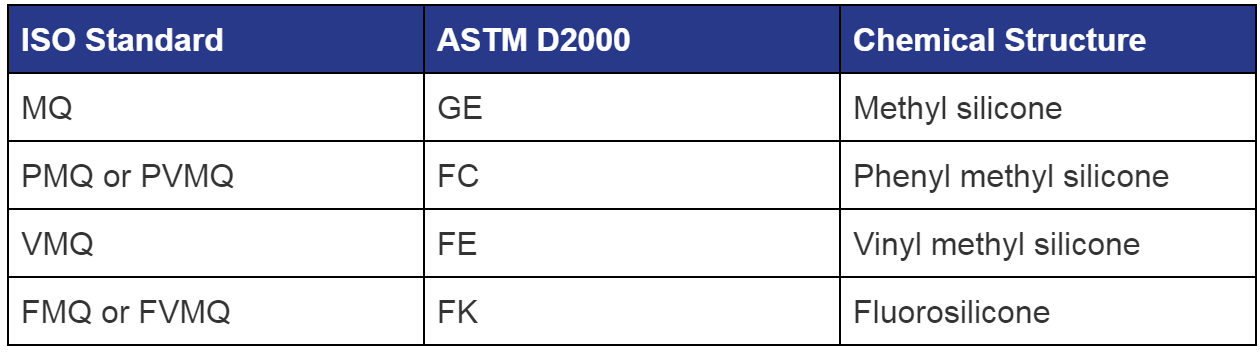 Continue reading →